
The MAGIC series (Boosey & Hawkes)
Easy pieces for the Early Grades
Leichte Stücke für Unter- bis Mittelstufe/
Pièces faciles pour les débutants
for solo woodwind or brass instrument with piano accompaniment
The Magic Clarinet | The Magic Flute | The Magic Saxophone | The Magic Trombone | The Magic Trumpet
This series of five books, one each for Clarinet, Flute, Saxophone, Trombone and Trumpet, includes classical repertoire from Monteverdi to Mozart from Brahms to Bartók and favourites such as 'When The Saints Go Marching In' and the 'Skye Boat Song'. The newest beginner will enjoy making music from the first few notes to the first concert.
Pieces from these books have appeared regularly on the exam syllabuses of the Associated Board of the Royal Schools of Music, the Guildhall School of Music & Drama, and Trinity College London.
Press Reviews: Winds, Summer 1993 “I do like the selection of music which Nicholas Hare has chosen for his Magic books. 24 pieces which range over a period of some four hundred years, will suit early graders. Excellent teaching material and good value!” Music Business, October 1993 |
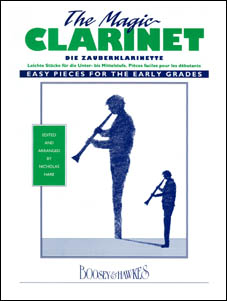 The Magic Clarinet
Die Zauberklarinette/La clarinette magique
25 pieces edited and arranged by Nicholas Hare
A varied and imaginative collection of first concert pieces. Includes classical repertoire from Schubert to Stravinsky and Brahms to Bartók plus folk, traditional and popular favourites. |
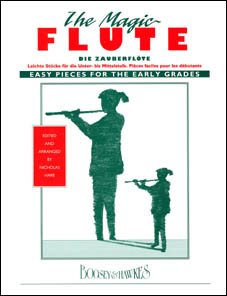 The Magic Flute
Die Zauberflöte/La flûte magique
22 pieces edited and arranged by Nicholas Hare
A varied and imaginative collection of first concert pieces. Includes classical repertoire from Schubert to Stravinsky and Shostakovich, Brahms to Bartók plus folk, traditional and popular favourites. |
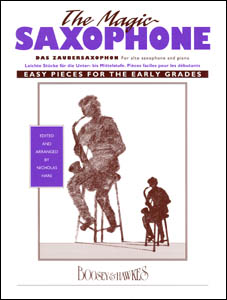 The Magic Saxophone
Die Zaubersaxophon/La saxophone magique
22 pieces edited and arranged by Nicholas Hare
A varied and imaginative collection of first concert pieces. Includes classical repertoire from Schubert to Stravinsky and Shostakovich, Brahms to Bartók plus folk, traditional and popular favourites. |
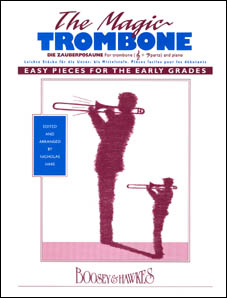 The Magic Trombone
Die Zauberposaune/Le trombone magique
24 pieces edited and arranged by Nicholas Hare
“THE MAGIC TROMBONE certainly has lived up to its title with my pupils. As a supplementary book, for grade 1 to 3 students, it contains interesting melodies that the inexperienced trombonist will find challenging but accessible. The source of material includes classical repertoire from Monteverdi to Mozart, Brahms to Bartók and a selection of popular tunes such as When the Saints and Tonight. The piano accompaniments are not always easy, but they are well written and enhance the solo part. The piano book has been printed with only one turn-over in the middle of a piece, which I would like to believe is due to good planning (Royal March of the Lions) [oh yes, it was! NH]. The educational value in this volume is vast, the trombone part having lots of contrasts in dynamics and plenty of directions for articulation. Full use of musical terms has also been included in the 24 melodies. The solo part is printed in both bass and treble clef (my trumpet pupils also enjoyed the book). If you are therefore looking for short solo items for a concert this book has some very listenable arrangements. I would expect The Magic Trombone to become an integral part of the trombone teacher’s tool kit. This is indeed a superb contribution to early grades repertoire.” CA/Winds, Summer 1993 |
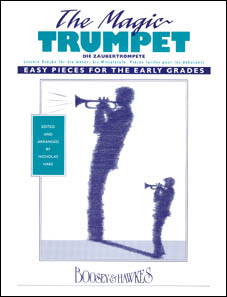 The Magic Trumpet
Die Zaubertrompete
22 pieces edited and arranged by Nicholas Hare
“THE MAGIC TRUMPET. The result first: the book has turned out well in all aspects. It is fun to play from. The edition contains 22 compositions from five centuries in mixed order. Apart from When the Saints it is so refreshing not to be offered the ‘usual’ trumpet repertoire, but pieces of different origins from traditional Scottish tunes, Claudio Monteverdi, Carl Czerny, Franz Schubert, Giuseppe Verdi, Igor Stravinsky, Béla Bartók, Dmitri Shostakovich to ‘Fats’ Waller and others. The arrangements – in keys favourable to wind instruments – don’t require a large note range from the trumpet (c’–e’’), nor are they technically difficult. This makes them ideal for non-advanced students. The same applies to the piano part. The pieces are mostly printed on single or double pages which avoids page turning for the piano accompanist. Notation and printing are of a high quality. Klaus Winkler/Üben & Muizieren 6/93 |